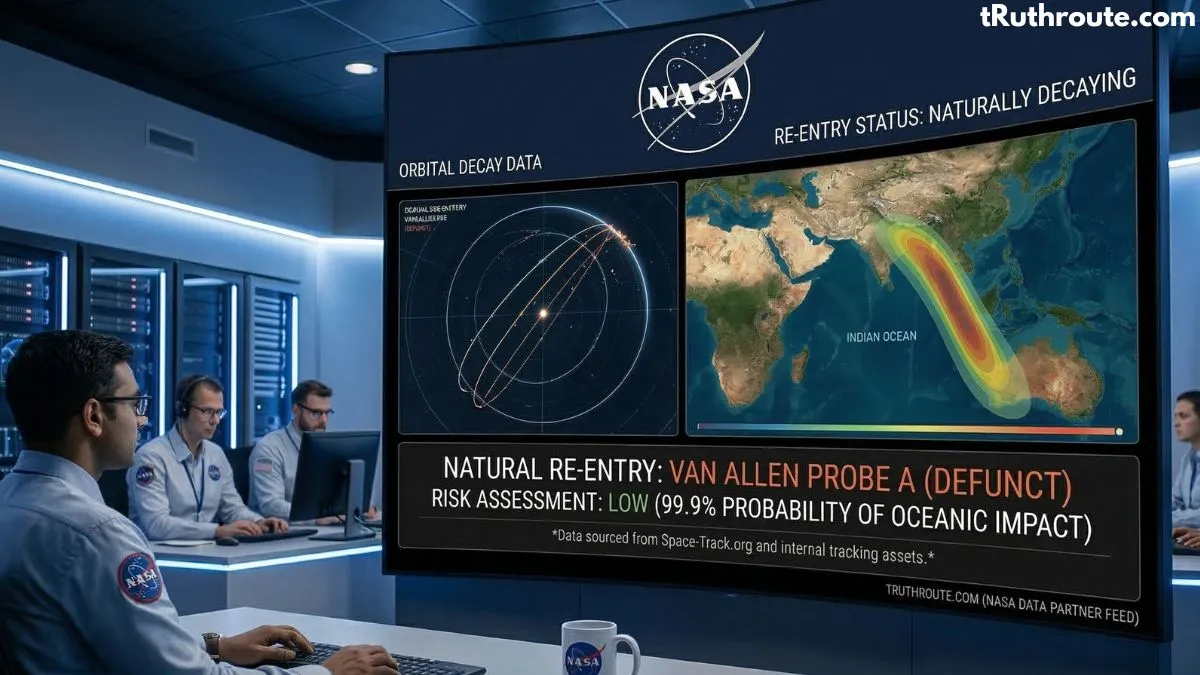
NASA Satellite Falling Toward Earth? What Experts Say About the Risk
Headlines about a NASA satellite falling toward Earth have a way of stopping people mid-scroll. The image they conjure — a hulking metal object hurtling from orbit toward a populated city — is vivid, alarming, and almost entirely disconnected from what actually happens when a satellite re-enters the atmosphere. But the gap between public perception and scientific reality on this topic is wide enough that it is worth closing properly.
Recent reports have confirmed that a satellite is in the process of an uncontrolled re-entry, meaning it is gradually losing altitude as atmospheric drag pulls it closer to Earth. Space agencies including NASA are tracking it in real time. Scientists have been running debris field calculations. And the consensus from every expert who has publicly commented on the situation is consistent: the risk to any individual person on the ground is extraordinarily low.
In this article, I walk through what satellite re-entry actually involves, how scientists calculate where debris might land, which regions face even the marginal risk that does exist, and what space agencies are doing to prevent this from becoming a recurring problem as orbital congestion grows.
Quick Facts: NASA Satellite Re-Entry at a Glance
| Detail | Information |
|---|---|
| Event Type | Uncontrolled atmospheric re-entry |
| Tracking Agency | NASA, ESA, US Space Command |
| Estimated Re-Entry Window | Subject to change — tracked in real time (check NASA’s official updates) |
| Percentage That Burns Up | Approximately 70–80% of most satellites disintegrate on re-entry |
| Debris Landing Zone | Oceanic landfall most probable given Earth’s surface composition |
| Lifetime Odds of Being Hit by Space Debris | Approximately 1 in 3,200 — spread across the entire global population |
| Last Major Debris Incident | China’s Long March 5B rocket, 2022 — landed in Indian Ocean |
| Official Tracking Source | NASA Orbital Debris Program Office, ESA Space Debris Office |
What Is Actually Happening: Understanding Satellite Re-Entry
Every satellite launched into low Earth orbit faces the same inevitable reality: the atmosphere, even at altitudes of several hundred kilometers, exerts a small but constant drag on objects moving through it. Over months or years, that drag gradually lowers a satellite’s orbit until it crosses the threshold where re-entry becomes unavoidable.
There are two types of re-entry. Controlled re-entry happens when a functioning spacecraft uses its thrusters to execute a precisely targeted deorbit burn, directing itself toward a remote ocean zone — most commonly the South Pacific Ocean Uninhabited Area, informally known as the “spacecraft cemetery.” The International Space Station will use a controlled re-entry when its mission concludes.
Uncontrolled re-entry is what happens when a satellite has exhausted its fuel, lost communications, or was simply launched without a deorbit capability — which was standard practice for decades before space agencies introduced end-of-life disposal requirements. The satellite drifts lower and lower until the atmosphere grabs it. At that point, where it lands is governed by physics and probability rather than human planning.
The satellite currently in the news falls into this second category. It has completed its operational mission, it has no remaining propulsion capability, and it is descending along a trajectory that scientists are modeling with increasing precision as re-entry approaches.
How Scientists Calculate Where Debris Will Land
Predicting exactly where re-entry debris lands is one of the more genuinely difficult problems in orbital mechanics, and the scientists who work on it are honest about its inherent uncertainty. The challenge is not tracking the satellite — ground-based radar and space-based surveillance systems do that with high precision. The challenge is predicting atmospheric behavior across the re-entry corridor with enough accuracy to narrow the landing zone below a few thousand kilometers.
The re-entry prediction process starts with US Space Command’s 18th Space Defense Squadron, which maintains a catalog of every tracked object in orbit and publishes daily updates on objects approaching re-entry. NASA’s Orbital Debris Program Office runs parallel analysis. The European Space Agency’s Space Debris Office in Darmstadt, Germany, contributes additional modeling for significant re-entry events.
The primary variables that drive the landing prediction include the satellite’s current orbital altitude and decay rate, the atmospheric density profile along the descent path (which varies with solar activity), the satellite’s mass and surface area (which determine how much drag it experiences), and the structural materials that determine how much of the object burns versus survives re-entry intact.
The practical prediction window for most uncontrolled re-entries narrows to a reliable estimate only in the final hours before atmospheric contact, because small variations in upper-atmosphere density compound over time into significant differences in where the object actually enters the lower atmosphere.
Why Re-Entry Windows Are So Wide Until the Last Moment
Most news coverage of satellite re-entry events reports a window of plus or minus several hours, which translates to a ground track spanning multiple continents. This frustrates readers who want a precise answer, but the uncertainty is genuine rather than evasive. An object traveling at roughly 28,000 kilometers per hour covers approximately 700 kilometers of ground track every 90 seconds. A two-hour uncertainty window represents a potential landing corridor stretching more than 50,000 kilometers — nearly the full circumference of Earth along that orbital path.
From my experience following space debris events over several years, the most reliable estimates arrive within the last four to six hours before re-entry. At that point, atmospheric modeling has enough real-time density data to narrow the window substantially. Even then, the final debris field often lands 10 to 20 minutes outside the final predicted window.
My POV: The wide uncertainty windows that agencies publish are not a sign of incompetence — they are a sign of scientific honesty. I find it far more reassuring when NASA says “we expect re-entry between X and Y with a ground track crossing these regions” than when a non-expert source claims to know exactly where it will land three days out. Precision that does not exist is not comforting. Transparent uncertainty from credible scientists is.
How Much Actually Survives Re-Entry — and Why It Matters
The popular assumption is that objects falling from orbit arrive intact. The physical reality is almost the opposite. When a satellite hits the upper atmosphere at orbital velocity — typically between 25,000 and 28,000 kilometers per hour — the friction generates temperatures exceeding 1,600 degrees Celsius. Most satellite components, including solar panels, aluminum structural frames, fuel tanks (if empty), and electronic assemblies, vaporize completely in this environment.
What survives are components made from materials with exceptionally high melting points — primarily titanium alloy fuel tanks, stainless steel reaction wheels, and certain dense optical components. These objects are smaller, denser, and slower than the original satellite by the time they reach lower altitudes. They typically arrive at the surface at terminal velocity, which for most surviving debris fragments is somewhere between 160 and 500 kilometers per hour depending on mass and aerodynamics.
For a typical satellite of several hundred kilograms in orbit, NASA estimates that between 20 and 40 percent of the original mass survives to ground level, distributed across a debris field that can stretch 500 to 1,000 kilometers in length. The surviving pieces are not a single large chunk — they are a scattered collection of components, some as small as a fist, others potentially as large as a car engine block for very large spacecraft.
What Others Miss: The Survivability Calculation Gap
Most coverage of satellite re-entry focuses on the probability of debris reaching the ground, but almost none of it explains the survivability calculation that agencies actually use to determine whether an uncontrolled re-entry is acceptable from a safety standpoint. NASA’s standard is a casualty expectation of less than 1 in 10,000 for any uncontrolled re-entry. This means the statistical expected number of human casualties from the debris field must be below 0.0001 before the re-entry is considered compliant with safety guidelines.
This calculation factors in the debris footprint area, the probability of ocean versus land impact, population density across the ground track, and the probability that a surviving fragment actually strikes a person rather than landing in an empty field, a parking lot, or a body of water. When you run those numbers for most satellites, the casualty expectation comes out well below the threshold — which is why agencies classify the public risk as low even when the debris field itself is non-trivial in size.
What Is the Actual Risk to You? The Numbers in Plain Terms
I want to address this question directly rather than burying the answer in caveats, because it is the question most readers actually came here to answer.
The odds that any specific person on Earth is struck by debris from a satellite re-entry are, in any practical sense, negligible. The often-cited figure is approximately 1 in 3,200 — but this represents the cumulative lifetime odds for every person on Earth simultaneously, not the odds for any single individual. Divided across the roughly 8 billion people currently alive, the individual probability per re-entry event is closer to 1 in 26 trillion.
For context: the odds of being struck by lightning in a given year in the United States are approximately 1 in 1.2 million, according to the National Weather Service. The odds of dying from a bee sting are roughly 1 in 6 million. The odds of a satellite debris fragment landing on a specific person are many orders of magnitude lower than either of these.
The surface of Earth is approximately 510 million square kilometers. Roughly 71 percent of that is ocean. Of the remaining 29 percent that is land, large portions are uninhabited — Antarctica, the Sahara, the Amazon, the Siberian interior, the Australian outback. The mathematical probability that the small surviving debris field from any given re-entry lands on a populated area, and specifically on a person within that area, is genuinely minuscule.
Regions With Marginally Higher Risk — and Why
While the global risk is extremely low, it is not perfectly uniform across all locations. The ground track of a re-entering satellite is determined by its orbital inclination — the angle of its orbit relative to the equator. Most research and Earth observation satellites operate in orbits inclined between 50 and 98 degrees, meaning their ground tracks cover a wide swath of Earth’s surface between those latitudes.
Regions that fall within the satellite’s orbital ground track have a higher probability of being in the debris corridor than regions outside it. For mid-inclination orbits, this typically includes most of North America, Europe, Central Asia, China, Japan, India, and large parts of Africa and South America.
The USA, given its geographic size and latitude position, falls within the ground track of most mid-inclination satellites. However, the probability of debris landing in any specific US city or region is still extraordinarily low, for all the reasons I outlined above. The continental US covers approximately 7.7 million square kilometers. Even a debris field stretching 1,000 kilometers in length and several kilometers in width represents a tiny fraction of that area.
USA-Specific Context
American readers following this story should know that NASA and the Federal Emergency Management Agency have coordinated response protocols for satellite re-entry events. These protocols are not activated out of expectation that debris will land in a populated US area — they are activated as a precaution, as standard procedure for any re-entry event whose ground track crosses US territory.
If you are in the continental US and concerned about this event, the practical guidance from space agencies is simple: there is no reason to take shelter, change your plans, or treat this as a personal safety emergency. Monitor NASA’s official updates if you are curious, but this situation does not warrant the same response as a hurricane, tornado warning, or earthquake alert.
My POV: I have noticed that satellite re-entry stories generate a level of public anxiety that is genuinely disproportionate to the actual risk, and I think the media framing of “falling toward Earth” carries significant responsibility for that. A more accurate framing would be “burning up in the atmosphere with a small fraction of material potentially reaching the ground in a remote location.” That headline does not generate the same clicks, but it is far closer to the truth of what is actually happening.
Space Debris Monitoring: How Agencies Track Thousands of Objects Right Now
The satellite currently in the news is one of roughly 27,000 tracked objects in Earth orbit, according to NASA’s Orbital Debris Program Office. Of these, approximately 3,000 are active satellites. The remaining 24,000 are defunct satellites, spent rocket stages, mission-related debris, and fragments from past in-orbit collisions and anti-satellite weapons tests.
Tracking this debris population requires a global network of ground-based radar and optical telescope systems. In the United States, the primary tracking infrastructure is operated by US Space Command, which maintains the official Space Object Catalog. The Space Surveillance Network uses a combination of dedicated radar facilities and optical observatories to track objects as small as 10 centimeters in low Earth orbit and as small as 1 meter in higher orbits.
The European Space Agency runs parallel tracking operations through its Space Debris Office at ESOC in Darmstadt, Germany. The agency uses a combination of the US Space Object Catalog data and independent European surveillance assets to maintain its own debris catalog and publish re-entry forecasts for significant objects.
For objects below the tracking threshold — estimated at several hundred thousand fragments between 1 and 10 centimeters — no current system provides reliable detection or tracking. This population represents a significant concern for operational satellites and the International Space Station, which performs avoidance maneuvers several times per year based on Space Command collision probability assessments.
How Real-Time Re-Entry Tracking Works
As a satellite approaches re-entry, tracking update frequency increases from daily to hourly to near-continuous in the final six hours. Radar facilities measure the object’s altitude, velocity, and orbital decay rate at each pass, feeding data into propagation models that calculate the expected re-entry time and ground track. These models are updated with each new observation, which is why the uncertainty window narrows progressively as re-entry approaches.
The Future of Satellite Safety: How the Industry Is Changing
The satellite responsible for the current news cycle was launched in an era when end-of-life disposal was not a regulatory requirement. That is changing — slowly, but meaningfully. The space industry and its regulators are in the early stages of implementing standards that would prevent today’s situation from repeating at scale as satellite launches increase dramatically with the growth of large commercial constellations.
NASA’s current guideline for low Earth orbit debris mitigation is the 25-year rule: satellites in LEO should deorbit within 25 years of the end of their mission, either through passive orbital decay or active propulsion. This rule is under review, with both NASA and the Federal Communications Commission pushing for a tighter 5-year standard for commercial satellite operators.
The FCC adopted a 5-year deorbit rule for new US-licensed satellites in 2022, marking a significant tightening of disposal requirements. The rule applies to satellites in orbits below 2,000 kilometers and requires operators to demonstrate a credible deorbit plan before receiving launch authorization. International adoption of comparable standards, however, remains inconsistent.
Beyond deorbit rules, the emerging field of active debris removal is attracting significant investment and engineering effort. Companies including Astroscale in Japan and ClearSpace (backed by the European Space Agency) are developing spacecraft specifically designed to rendezvous with defunct satellites and deorbit them in a controlled manner. The first operational active removal missions are expected to fly by the mid-2020s.
Comparison: Controlled vs. Uncontrolled Re-Entry — Key Differences
| Factor | Controlled Re-Entry | Uncontrolled Re-Entry |
|---|---|---|
| Landing Zone Precision | High — targeted ocean impact zone | Low — wide corridor, narrows near re-entry |
| Public Risk Level | Near zero | Very low but non-zero |
| Requires Remaining Fuel | Yes | No (passive decay) |
| Used For | Crewed spacecraft, large stations, planned missions | Legacy satellites, early-era spacecraft |
| Predictability | Hours-precise | Days to hours window |
| Agency Preference | Strongly preferred by NASA, ESA | Tolerated only below casualty threshold |
| Example | ISS deorbit plan, Mir in 2001 | Skylab 1979, this current event |
Common Mistakes and Misconceptions About Satellite Re-Entry
The most persistent misconception is that “falling from orbit” means something is dropping straight down like a rock thrown from a building. Objects in orbit are not falling in that sense — they are traveling horizontally at enormous speed and gradually spiraling inward as drag slows them. Re-entry is a process that unfolds over weeks or months, not a sudden plunge.
The second major misconception is that debris arrives at something close to orbital speed. By the time surviving fragments reach lower altitudes, they have decelerated massively through atmospheric friction. Terminal velocity for most debris fragments is far below orbital speed — comparable in many cases to a ball dropped from a tall building, not a hypervelocity projectile. This does not make debris harmless, but it fundamentally changes the risk profile compared to what most people imagine.
The third misconception is that NASA is concealing information about where the debris will land. Space agencies publish their best predictions openly and update them as frequently as their models allow. The reason those predictions are imprecise is physics, not policy. Upper atmospheric density is variable, solar activity affects that density, and orbital mechanics propagation compounds small errors over time. There is no hidden precise landing point that agencies are withholding.
Key Takeaways
- The satellite currently re-entering Earth’s atmosphere is following the physics of uncontrolled orbital decay — a natural end-of-life process for satellites without remaining propulsion capability.
- Approximately 70 to 80 percent of most satellites burn up completely during atmospheric re-entry. Only dense, high-melting-point components like titanium tanks and reaction wheels typically survive to ground level.
- The individual probability of being struck by satellite debris for any single person is many orders of magnitude lower than being struck by lightning — in the range of 1 in several trillion per event.
- Precise landing zone prediction is only possible in the final hours before re-entry because upper atmospheric variability compounds into large ground track uncertainties over longer timeframes.
- Given Earth’s surface composition, oceanic impact is statistically the most probable outcome for any uncontrolled re-entry event.
- The space industry is moving toward stricter disposal requirements and active debris removal technology, though implementation remains uneven across international operators.
Frequently Asked Questions: NASA Satellite Re-Entry
Is it safe to go outside during a satellite re-entry?
Yes. The probability of debris landing anywhere near you during an uncontrolled re-entry is statistically negligible. Space agencies do not advise sheltering in place or restricting outdoor activity for standard satellite re-entry events. Normal daily activity should continue without modification unless a specific official authority issues a targeted warning for your region — which has not happened for this event.
How do I track the satellite re-entry in real time?
The most reliable sources for real-time tracking data are NASA’s Orbital Debris Program Office at orbitaldebris.jsc.nasa.gov, the European Space Agency’s Space Debris Office at sdup.esoc.esa.int, and US Space Command’s public space track portal at space-track.org. These organizations publish updated re-entry predictions as new tracking data becomes available.
Could the debris land in the United States?
Depending on the satellite’s orbital inclination, the continental US may fall within the possible ground track. However, the probability of debris landing in any specific location within that track is extremely low. Given that oceans cover 71 percent of Earth’s surface and large portions of land are uninhabited, the statistical probability of debris reaching a populated US area is very small. NASA and FEMA have standard protocols for such events but have not activated any public safety warnings for the current re-entry.
What happens if a piece of debris lands on someone’s property?
Under the 1972 Outer Space Liability Convention, the launching state is liable for damage caused by its space objects on Earth’s surface. If debris from a NASA satellite damages property or causes injury, the US government is legally responsible for compensation under this international treaty. There are historical precedents — most notably Canada’s successful claim against the Soviet Union following the Cosmos 954 nuclear-powered satellite re-entry in 1978.
Why do some satellites have controlled re-entry and others do not?
Controlled re-entry requires a functioning propulsion system and available fuel at end of mission. Many older satellites were designed and launched before controlled disposal was a regulatory requirement, and some were designed for fixed operational lifespans with no fuel reserve allocated for deorbit. Modern satellite designs increasingly include deorbit propulsion as a standard requirement, particularly under newer FCC and NASA guidelines.
Has anyone ever been hit by falling satellite debris?
No confirmed human fatality or serious injury from satellite debris has ever been recorded. One widely cited incident involves Lottie Williams of Tulsa, Oklahoma, who in 1997 was reportedly struck on the shoulder by a small fragment believed to be from a Delta II rocket re-entry. The fragment caused no injury. Property damage from uncontrolled re-entry debris has occurred on multiple occasions, with the most significant incidents involving large rocket stages rather than satellites.
What is NASA doing to prevent this from happening with future satellites?
NASA’s Orbital Debris Program Office develops and enforces debris mitigation guidelines for all NASA missions. Current guidelines require that satellites in low Earth orbit deorbit within 25 years of mission end, a standard under review for tightening to five years. NASA also contributes to international debris mitigation guidelines through the Inter-Agency Space Debris Coordination Committee, which sets standards that space agencies worldwide are encouraged to adopt.
Conclusion: What This Moment Actually Tells Us About Space Safety
The satellite currently falling toward Earth is a product of a different era in space operations — one where the long-term management of orbital debris was not part of the mission design conversation. That era is ending, but its legacy remains in the form of thousands of defunct objects still circling the planet, each on its own timeline toward re-entry.
The direct risk from this specific event to any person on the ground is genuinely negligible. The scientific community is unanimous on that point, and the data supports it. What this event does represent is a visible reminder that Earth’s orbital environment requires far more careful stewardship than it has historically received, and that the industry’s shift toward responsible end-of-life planning is not optional — it is essential as satellite numbers grow.
If you are following this story out of curiosity rather than anxiety, I think that is exactly the right orientation. Track the updates through NASA’s official channels. Watch the re-entry prediction window narrow over the coming hours. And appreciate that the engineers, physicists, and orbital analysts working this problem are doing genuinely difficult science in real time — with transparency about what they know and honesty about what they do not.
I will update this article as the re-entry window narrows and final tracking data becomes available.