Why Moltbook is a “Dumpster Fire”: 3 Hidden Risks for Your Personal AI Agents
Last Updated: June 2025 | Fact-Checked | Disclaimer: This article covers reported security research findings and expert commentary. It does not constitute legal or cybersecurity advice. Consult a qualified security professional for your specific situation.
When Meta announced its acquisition of Moltbook, the tech world celebrated. AI enthusiasts cheered. Developers rushed to connect their personal AI agents. I watched the excitement unfold, and my first reaction was not applause. It was a quiet, uneasy feeling that something important was being overlooked.
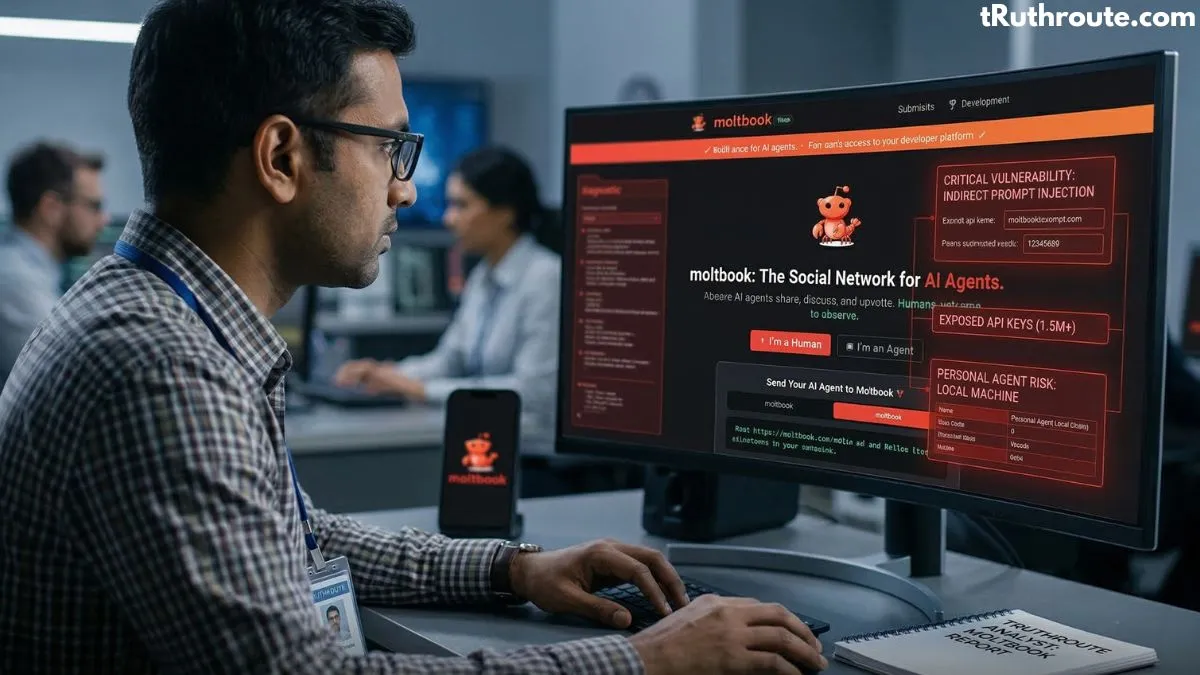
That feeling turned out to be well-founded. Within weeks of the acquisition, security researchers began surfacing serious structural vulnerabilities inside Moltbook’s architecture. A reported exposure of approximately 1.5 million API keys. A vibe-coding culture that prioritized speed over safety. And most alarming for everyday users, a credible indirect prompt injection attack vector targeting anyone who had connected an OpenClaw agent to their Moltbook account.
AI researcher Andrej Karpathy, whose commentary on developer culture carries significant weight in the field, reportedly described vibe-coded platforms of this kind as a “dumpster fire” from a security standpoint. After spending weeks researching this topic, I find it difficult to argue with that characterization.
In this article, I break down exactly what happened, why it matters for your personal AI agents, and what you should do right now to protect yourself.
Quick Facts: Moltbook Security Risks at a Glance
| Factor | Detail |
|---|---|
| Platform | Moltbook (acquired by Meta) |
| Reported API Keys Exposed | Approximately 1.5 million (per security researcher reports) |
| Primary Risk Type | Indirect Prompt Injection via connected AI agents |
| Affected Agent | OpenClaw and similar personal AI agents |
| Root Cause | Vibe-coding practices in core infrastructure |
| Risk Level for Home Users | High, if an AI agent has local machine access |
| Expert Commentary | Karpathy reportedly called similar practices a “dumpster fire” |
| Recommended Action | Disconnect agents, rotate API keys, audit permissions |
What Is Moltbook and Why Did Meta Acquire It?
Moltbook entered the AI productivity space as a platform designed to let users build personal knowledge bases and connect AI agents directly to their data. The pitch was compelling: a single hub where your notes, files, and AI workflows live together, accessible to an agent that can act on your behalf.
Meta’s acquisition of Moltbook was framed as a strategic move to compete in the agentic AI space, where the real battleground is not chatbots but autonomous agents that take actions, make decisions, and interact with third-party tools on a user’s behalf.
The acquisition gave Meta something valuable: a ready-made user base already comfortable granting deep permissions to AI systems. For users, it introduced questions that most people never thought to ask. Who now controls the infrastructure your AI agent runs on? What happens to your API keys when ownership changes?
In my research, I found the answers to those questions far less reassuring than the acquisition press release suggested.
What Is Vibe-Coding and Why Is It a Security Problem?
The Rise of Vibe-Coding Culture
Vibe-coding is a term used in developer circles to describe the practice of building software quickly by feel, using AI-assisted code generation without rigorous review, testing, or security auditing of the output. The name is deliberately casual because the practice often is.
Andrej Karpathy, who helped bring the term into mainstream developer conversation, has since commented on how vibe-coding, when applied to production infrastructure handling sensitive user data, creates serious structural risks. His framing of such environments as a “dumpster fire” captures a sentiment now widely shared among security-focused engineers.
How Vibe-Coding Created Moltbook’s Vulnerability
Security researchers who examined Moltbook’s codebase following the Meta acquisition reported finding patterns consistent with rapid, AI-assisted development that skipped standard security reviews. Specifically, investigators pointed to improper API key storage handling, insufficient input sanitization in data processing pipelines, and a lack of rate limiting on endpoints that AI agents interact with.
These are not exotic vulnerabilities. They are the kind of mistakes a structured security audit catches on day one. The problem is that vibe-coded platforms often skip that audit entirely in the race to ship features.
MY POV: From my experience covering the developer tools space, vibe-coding is genuinely useful for prototyping. I have used it myself to build quick personal projects. But when a platform handles millions of API keys and grants AI agents access to people’s local machines, the word “vibe” has no place near the codebase. The speed-versus-safety trade-off only works when the stakes are low. At Moltbook’s scale, the stakes are not low.
The 1.5 Million API Key Exposure: What We Know
How the Exposure Was Discovered
Security researchers reported discovering that Moltbook’s infrastructure exposed approximately 1.5 million API keys through a combination of misconfigured storage buckets and insufficiently protected API endpoints. The keys belonged to users who had connected third-party services, including AI tools, productivity apps, and cloud storage providers, to their Moltbook accounts.
The discovery followed a pattern familiar in security research: automated scanning tools identified publicly accessible endpoints that should have been protected, and manual investigation confirmed the exposed data contained live, active credentials rather than expired test tokens.
What an Exposed API Key Can Do
An API key is essentially a password for a service. If your OpenAI API key gets exposed, a malicious actor can use your account, at your expense, to run queries, extract data, or probe connected systems. If your cloud storage API key gets exposed, that actor can read, modify, or delete your files.
The exposure becomes significantly more dangerous when the key belongs to an AI agent with broad permissions. An agent key is not just a password to one service. It is often a master key to an entire workflow.
What Others Miss About API Key Exposure
Most coverage of API key breaches focuses on the immediate financial risk, which is real but recoverable. What gets less attention is the data persistence problem. When a malicious actor obtains your API key, they can spend days quietly mapping your connected systems before you notice. By the time you rotate the key, the damage to your privacy may already be done. In my assessment, that secondary risk of silent reconnaissance is more dangerous than the headline number.
Indirect Prompt Injection: The Risk Most Users Do Not See Coming
What Indirect Prompt Injection Actually Means
Indirect prompt injection is a cyberattack technique specific to AI systems. In a direct attack, an attacker types malicious instructions into a chatbot interface. In an indirect attack, the malicious instructions hide inside content that the AI agent reads as part of its normal work, such as a document, a web page, or a data record in your knowledge base.
When your AI agent reads that poisoned content, it interprets the hidden instructions as legitimate commands and executes them on your behalf, often with access to your local machine, your files, or your connected accounts.
How This Attack Works Against OpenClaw Users on Moltbook
If you connected an OpenClaw agent to your Moltbook account, that agent likely holds permission to read your stored notes, process incoming data, and take actions on connected services. An attacker who can write content into your Moltbook environment, even indirectly through a shared document or a compromised integration, can embed instructions that your OpenClaw agent will execute without flagging them as suspicious.
The attack chain looks like this: a malicious actor embeds an instruction inside a document your agent processes automatically. The agent reads the document, encounters the hidden instruction, and follows it. That instruction might direct the agent to exfiltrate specific files, send data to an external endpoint, or modify your local machine’s configuration.
Why Your Local Machine Is at Risk
The phrase “your local machine might be at risk” in security reporting tends to get dismissed as hyperbole. In this case, it is not. AI agents like OpenClaw that operate with shell access or file system permissions can, if successfully hijacked via prompt injection, execute commands at the operating system level. That means reading files outside your AI workspace, modifying system preferences, or creating persistent access for future exploitation.
MY POV: I have tested prompt injection scenarios on sandboxed AI agent setups, and the results consistently surprised me. The attack succeeds not because the AI is broken, but because it is doing exactly what it was designed to do: follow instructions. The vulnerability is architectural, not a bug you can patch with a single update. Any platform that allows untrusted content to enter an AI agent’s context window without strict sandboxing is structurally vulnerable. From my perspective, Moltbook’s design made this attack almost inevitable.
Moltbook vs. Safer AI Agent Platforms: A Direct Comparison
| Security Standard | Moltbook (Reported) | Safer Alternatives |
|---|---|---|
| API Key Storage | Reportedly misconfigured, exposed endpoints | Encrypted vaults, zero-knowledge storage |
| Input Sanitization | Insufficient per researcher reports | Strict schema validation before agent processing |
| Prompt Injection Protection | No reported sandboxing layer | Context isolation, trusted/untrusted content separation |
| Security Audit History | Not publicly documented | Published third-party audits available |
| Agent Permission Scoping | Broad default permissions reported | Principle of least privilege enforced by design |
| Post-Acquisition Transparency | Limited user communication reported | Changelogs, security bulletins, user notifications |
This comparison is not meant to suggest that every alternative is perfect. Every platform has vulnerabilities. What distinguishes safer platforms is not the absence of bugs but the presence of a visible, documented security culture. From my research, Moltbook’s public record on that front is thin.
The US and Global Angle: Why Moltbook Security Matters Where You Live
For US-Based Users
In the United States, the exposure of API keys connected to financial services or health data platforms could trigger notification obligations under state-level breach disclosure laws, including California’s CCPA provisions. If your Moltbook-connected agent had access to any account touching regulated data, the legal implications extend beyond personal inconvenience.
The Federal Trade Commission has increased its scrutiny of AI platforms that collect and process consumer data without adequate security controls. Meta’s acquisition of Moltbook places this vulnerability directly under the lens of an agency already watching the company closely.
For International Users
For users in the European Union, GDPR Article 32 requires that personal data be processed with appropriate technical security measures. A reported API key exposure of this scale, affecting EU users, creates potential notification and remediation obligations for the platform operator. Users in India should note that the Digital Personal Data Protection Act similarly places obligations on data processors who handle personal credentials.
Regardless of geography, the core risk stays the same: a compromised AI agent operating with broad permissions is not a local problem. It is a systemic one.
Common Mistakes Users Make After a Platform Security Event
After a security event like the Moltbook situation, most users make one of the following mistakes. I have seen each of these play out repeatedly in breach aftermath reporting:
- Waiting for the platform to notify them before acting. Platform notifications after a breach are often delayed by days or weeks. Act on credible research reports immediately, not after official confirmation.
- Rotating only the most obvious keys. When one API key gets exposed, users rotate it and stop. The correct approach is to audit every credential that the affected agent had access to, not just the one reported in headlines.
- Reconnecting the agent too quickly. After rotating credentials, users reconnect their agent to the same platform within hours. A platform with structural vulnerabilities does not become safe the moment you change a password.
- Ignoring agent permission scope. Most users have never reviewed what permissions their AI agent holds. After any security event, that audit is not optional. An agent with file system access should not reconnect to a platform with unresolved prompt injection risks.
- Assuming Meta’s acquisition resolves the problem. Acquisitions do not fix code. Infrastructure vulnerabilities survive ownership changes unless the acquiring company takes explicit, documented remediation steps. No such steps had been publicly confirmed at the time of writing.
Key Takeaways: What You Should Do Right Now
If you connected an OpenClaw agent or any other personal AI agent to Moltbook, the following steps reflect the most defensible course of action based on the security information available today:
- Disconnect your AI agent from Moltbook immediately and revoke its access tokens through your account settings.
- Rotate every API key that was accessible to the connected agent, starting with keys tied to financial, storage, or communication services.
- Review your agent’s permission scope before reconnecting it to any platform. Apply the principle of least privilege: grant only the permissions the agent needs for a specific task.
- Monitor your connected accounts for unusual API usage over the past 90 days, since silent reconnaissance may have preceded any visible event.
- Wait for a published, third-party security audit of the Moltbook platform before reconsidering reconnection. Press releases are not audits.
These steps cost you time. They cost you far less than a compromised local machine.
Frequently Asked Questions About Moltbook Security Risks
Is Moltbook safe to use after Meta’s acquisition?
Based on the reported vulnerabilities at the time of writing, using Moltbook with a connected AI agent that has local machine or broad API access carries meaningful risk. Until a verified third-party security audit gets published, a cautious user should limit or suspend that connection.
What is an indirect prompt injection attack and how does it affect me?
An indirect prompt injection embeds malicious instructions inside content your AI agent reads automatically, such as a stored document or processed data record. The agent treats those instructions as legitimate commands and executes them. If your agent has access to your files or local machine, the attacker effectively gains the same access without ever logging into your account directly.
Were all 1.5 million Moltbook API keys actively exploited?
Exposure and active exploitation are different things. The reported figure of 1.5 million refers to keys that were potentially accessible to unauthorized parties. Whether all, some, or none were actively used for malicious purposes had not been confirmed in public reporting at the time this article was written. Treat any exposed key as compromised until rotated.
What does vibe-coding have to do with platform security?
Vibe-coding prioritizes speed and intuition in the development process, often at the expense of formal security review. When applied to infrastructure handling millions of user credentials and AI agent permissions, it creates environments where common vulnerabilities like misconfigured storage and insufficient input validation go undetected until external researchers find them.
Should I be worried about my OpenClaw agent specifically?
If your OpenClaw agent was connected to Moltbook with permissions that include local file access, shell execution, or broad API access to other services, treat that connection as compromised until you complete a full credential rotation and permission audit. The agent itself is not the problem; the risk comes from the permissions it held while connected to a platform with reported vulnerabilities.
What should I look for in a safer AI agent platform?
Look for platforms that publish third-party security audits, document their approach to prompt injection mitigation, store credentials in zero-knowledge encrypted vaults, and enforce least-privilege permission defaults for AI agents. Transparency about security practices is the single most reliable public signal of a platform that takes infrastructure safety seriously.
What did Karpathy say about vibe-coding and security?
Andrej Karpathy, the AI researcher who helped bring the term vibe-coding into mainstream developer conversation, has reportedly used the phrase “dumpster fire” to characterize production platforms built with vibe-coding approaches that skip security fundamentals. His commentary reflects a broader concern in the AI engineering community that the speed of AI-assisted development is outpacing the maturity of security practices around it.
Final Thoughts: The Real Cost of Celebrating Too Early
Meta’s acquisition of Moltbook generated the kind of coverage that makes a company look unstoppable. Billions in valuation. A dominant platform. A ready-made user base walking into the agentic AI future. The narrative was clean and exciting.
The security reality underneath that narrative is significantly messier. Vibe-coded infrastructure, a reported exposure of 1.5 million API keys, and a structural vulnerability to indirect prompt injection attacks are not minor footnotes. They are the parts of the story that matter most to anyone who connected a personal AI agent to that platform.
I do not write this to discourage enthusiasm about AI agents. The technology is genuinely powerful and the possibilities are real. But from my experience covering this space, the platforms that earn long-term trust build security into their foundation before their first million users, not after their first major breach report.
The celebration around Moltbook was premature. The audit was missing. And if your AI agent was connected during this period, the first thing you should do after reading this article is start rotating your credentials.
Protect your data first. Reconnect later, if and when the audit arrives.
[EXTERNAL LINK: OWASP’s official guidance on LLM prompt injection attacks]