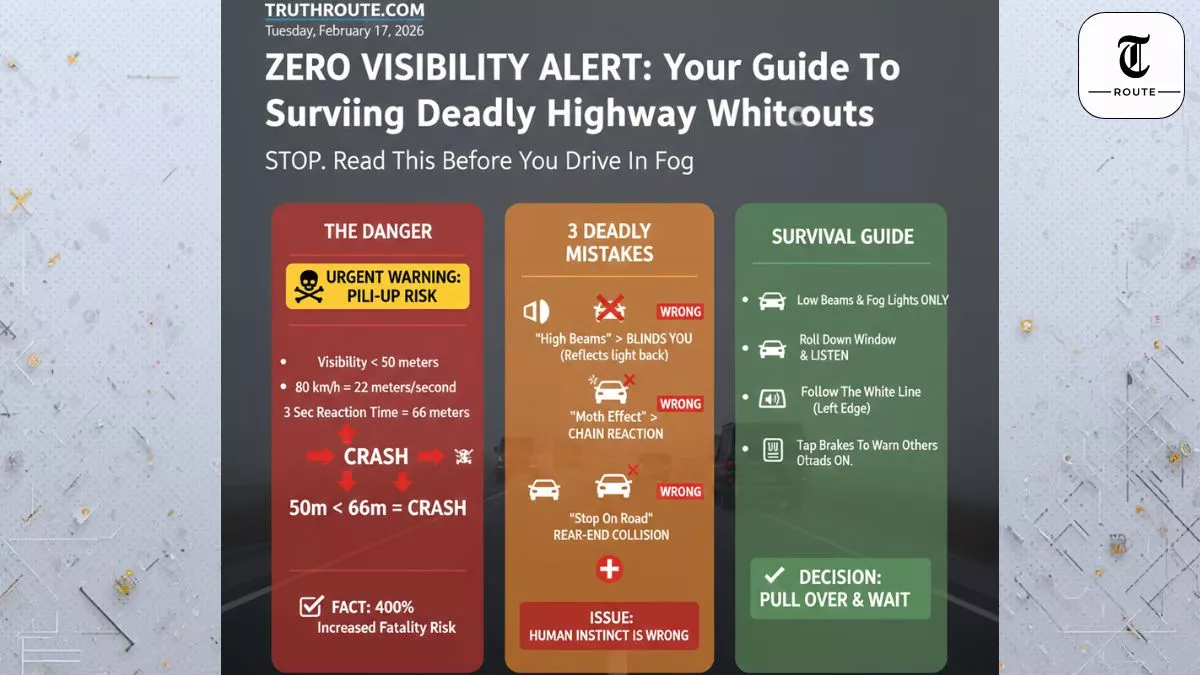
URGENT DRIVER WARNING: Meteorological departments have issued a “Zero Visibility” alert for multiple regions. Highway travel is currently rated as “High Risk.”
It happens in seconds.
One minute, you are cruising at 80 km/h. The next, a wall of white descends. The car in front of you vanishes. You slam on the brakes—but it’s too late. You hear the screech of tires behind you, followed by the sickening crunch of metal.
This isn’t just “bad weather.” This is a Zero Visibility Alert, and it is currently the #1 cause of massive chain-reaction pile-ups on our highways.
If you are planning to drive early in the morning or late at night this week, stop. Read this first. It might just save your life.
Table of Contents
Why “Zero Visibility” is a Death Trap
We often fear speeding or drunk drivers, but fog is a silent killer. When a Zero Visibility Alert is issued, it means visibility has dropped below 50 meters.
At 80 km/h, your vehicle travels roughly 22 meters per second.
Do the math: If visibility is 50 meters, and you take 3 seconds to react and brake, you have already traveled 66 meters. You will hit the obstacle before your foot even touches the brake pedal.
This is why you see 20, 30, or even 50-car pile-ups on news channels. One person brakes, the person behind them can’t see the brake lights in time, and the chain reaction begins.
The 3 Mistakes That Cause Pile-Ups
If you find yourself trapped in this whiteout, avoid these common instincts. They are deadly.
1. “I’ll Just Turn on My High Beams”
WRONG. This is the most dangerous thing you can do. High beams reflect off the water droplets in the fog and bounce straight back into your eyes, creating a “wall of light.” You will effectively blind yourself.
2. “I’ll Follow the Car Ahead Closely”
WRONG. Drivers subconsciously follow the taillights ahead to feel safe. This is called the “Moth Effect.” The problem? If that driver crashes or drives off a cliff, you will follow them right into the disaster.
3. “I’ll Stop on the Road”
WRONG. Panic makes drivers slam on brakes and stop in the middle of the lane. In zero visibility, the car behind you cannot see you are stopped until they are inches away. Being stationary on a highway in fog is a death sentence.
The Zero-Vis Survival Guide
If you cannot delay your trip and must drive, follow this military-grade safety protocol:
- Use Low Beams & Fog Lights ONLY: Keep light directed down at the road surface.
- Roll Down Your Window: Seriously. If you can’t see, you need to hear. Turn off the radio. Listen for sirens, screeching tires, or horns.
- Follow the White Line: Do not look at the center of the road. Look at the painted white line on the left/outer edge of the road. This ensures you stay in your lane and don’t drift into oncoming traffic.
- Tap Your Brakes: Don’t just brake hard. Tap them gently to flash your red taillights early, warning the driver behind you.
🚨 THE GOLDEN RULE: If visibility drops to zero, PULL OVER. But do not pull over on the shoulder. Get completely off the road (into a petrol pump, rest area, or grassy field). Turn your lights OFF so no one follows you, and keep your hazards ON.
Affected Regions (Check Your Route)
While this warning applies globally during winter, specific alerts are often active for:
- North India Plains: Punjab, Haryana, Delhi NCR, Uttar Pradesh.
- Central India: Parts of Madhya Pradesh (especially Gwalior/Rewa belts) and Bihar.
(Note: Always check your local meteorological app before starting the car.)
Conclusion: It’s Not Worth the Risk
No meeting, no delivery, and no event is worth your life.
A Zero Visibility Alert is nature’s way of saying “Road Closed.” If you look out your window and can’t see the streetlamp across the road, stay home. The risk of a fatal accident increases by 400% in these conditions.
Share this warning with your family immediately. Do not let them drive blind.
FAQ: Emergency Driving
Q: Should I use Hazard Lights (4-way blinkers) while driving?
A: Most experts say NO unless you are driving extremely slowly (below 20km/h). Hazard lights disable your turn signals. Drivers behind you won’t know if you are changing lanes.
Q: Does the car heater help?
A: Yes. Use the defogger setting (AC + Heater). Fog outside often causes condensation inside. You need your windshield crystal clear.
Q: What if I am on a highway and can’t pull over?
A: maintain a consistent speed (do not stop suddenly). Blow your horn periodically to announce your presence.